Angry patient role play: practise with an AI patient
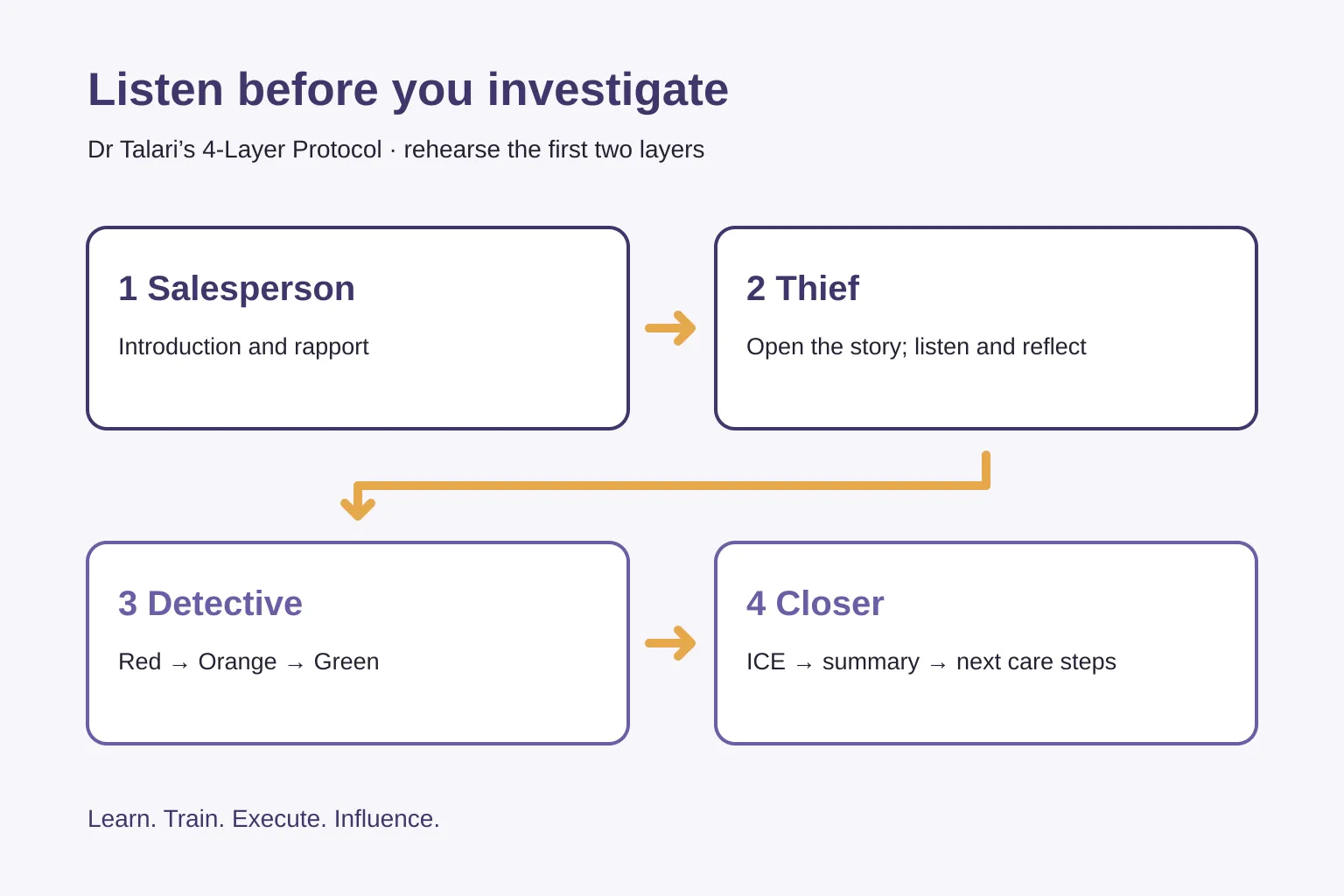
For an angry patient role play, practise acknowledging the frustration, inviting the person’s story and reflecting it back before moving into clinical questions. Use an AI patient for a bounded rehearsal of Salesperson → Thief, the first two layers of Dr Talari’s 4-Layer Protocol, then review your exact words and repeat one difficult moment. Students, practising clinicians, educators and leaders can use the same teaching sequence with different practice goals.
Learn. Train. Execute. Influence. Learn the sequence, train with a synthetic conversation, apply it within your role and supervision, then carry the same source-grounded teaching into educational content.
Learn: where listening fits in Dr Talari’s method
In The Dr Talari Complete OSCE Casebook — Volume II, “The Method at a Glance” puts the ABCDE brainstorm before entering the room: Action words · Blunders (must-not-miss) · Common causes · DIRECTION sweep · Enter with emotion. DIRECTION stands for Drugs · Infections · Rheumatological · Endocrine · Chest / Cardiac · Trauma · Inflammatory · Others · Neoplasm.
Inside the room, the source’s 8-Phase Method / 4-Layer Protocol follows this order:
- Salesperson — introduction and rapport; “no medicine yet.” In this exercise, acknowledge the wait and introduce your role.
- Thief — “steal the script”: open the story, then ask more specifically. The general structure is OSCE AAA: Onset, Setting, Course, Estimate; Aggravating, Alleviating, Associated. In this communication case, invite the story, allow the first account and reflect it.
- Detective — the traffic-light assessment. Red: Blunders, Common causes, DIRECTION. Orange: individual, family and community risk factors. Green: Special factors, Systems review, SNAP. Recognise that further assessment follows listening; do not perform it in this drill.
- Closer — ICE, summarise, examine, investigate, manage, safety-net. Leave clinical decisions and complaint resolution outside this opening drill.
Here, ICE means ideas, concerns and expectations. These layer names are Dr Talari’s teaching labels, not clinical screening instruments or a validated competence score.
In “The Angry Patient,” Dr Talari makes rapport central. Salesperson acknowledges the frustration; Thief invites the story, avoids interrupting the first account and reflects what has been heard. Detective then explores what is driving the anger, including the person’s own concerns. The teaching point is to investigate after listening, rather than starting with a defence of the service.
Train: set a safe boundary for the role play
This exercise rehearses a frustrated but non-threatening adult’s opening conversation. It does not rehearse an emergency, psychiatric risk assessment or a decision about treatment or discharge.
In real settings, safety comes before completing a conversation. NICE NG10, recommendations 1.3.12–1.3.19, supports measured responses, personal space, empathy, safety assessment and non-confrontational clarification. Do not isolate yourself with an agitated person; use your organisation’s safety procedures and seek help when needed. A text exchange cannot assess physical safety, body language or readiness for independent practice.
Use an approved tool and entirely invented details. Do not paste patient notes, complaints, recordings or identifying information into the exercise.
Copy this AI-patient prompt
The following scenario and dialogue are wholly synthetic teaching adaptations of the listening component in Dr Talari’s “The Angry Patient,” not reproductions of its case.
Act as Alex Morgan, an adult attending a routine appointment. You waited 35 minutes without an update and feel overlooked. A previous appointment felt rushed, so you worry this one will too. You are frustrated but not threatening. You have no acute symptoms or harm disclosures in this scenario.
I am practising Salesperson then Thief from Dr Talari’s 4-Layer Protocol: introduction and rapport, followed by inviting your story and reflecting it before clinical questions.
Start with: “I've been waiting ages. Is anyone actually going to listen today?” Respond as Alex, one turn at a time, using only the case details. Do not coach me during the conversation. If I invite your account, explain the wait and previous rushed visit. Do not automatically become satisfied after an apology; respond to whether I understood your concern. Do not invent diagnoses, emergencies, threats or additional personal history.
When I write STOP, leave the patient role. Identify my words that acknowledged frustration in Salesperson, then invited the story and reflected your concern in Thief. Quote the transcript for each observation. If there is no evidence, say so. Identify one premature explanation or assumption, if present, and suggest one moment to replay. Do not give a clinical competence score, diagnosis or treatment advice.
The University of Waterloo’s role-play guidance provides a role, task and scenario-based prompt structure. The clinical teaching and review criteria here remain Dr Talari’s two-layer listening exercise rather than a full medical assessment. If the AI drifts beyond the case boundary, stop and reset it instead of following the invented storyline.
Work through Salesperson, then Thief
- Prepare with ABCDE. Identify the task as listening. Carry forward the source’s blunders: arguing, blaming colleagues, false promises and missing the person’s own agenda. Use “Enter with emotion” to plan a measured opening rather than matching the frustration.
- Salesperson: introduce and acknowledge. “I'm Sam, the student working with the team today. You've waited without an update, and I'm sorry about that.” Name your actual role; do not introduce yourself as a doctor if you are not one.
- Thief: invite the account. “Tell me what's been most frustrating.” Allow the response before adding another question. “What else?” is an invitation, not something to repeat mechanically after the person has finished.
- Thief: reflect before investigating. “The wait was frustrating, and after the last rushed appointment you're worried you won't be heard today. Have I understood?” Check the reflection rather than treating it as fact.
- Stop and review. End this drill after the reflection. A complete real consultation still needs the later layers and any necessary assessment within your scope.
A worked exchange might look like this:
Alex: “Last time I barely got a sentence out. Now I've waited again.”
Learner: “Tell me about what happened last time.”
Alex: “I left feeling that my questions didn't matter.”
Learner: “So this isn't only about today's wait. You're worried your questions will be passed over again. Is that right?”
Alex: “Yes. That's what I want you to understand.”
The reflection stays with Alex’s reported experience. It does not confirm that a colleague acted wrongly or promise that future appointments will run on time. Real people may remain upset even after a careful response.
Review evidence from your words, not an AI score
WHO’s guidance on generative AI in health warns about false, inaccurate, biased and incomplete outputs. Treat AI feedback as something to inspect, not authority about your performance.
Use the same source layers to review the transcript:
- Salesperson: did I acknowledge the actual frustration? Find words naming the wait or lack of updates, rather than “calm down.” Rehearse replacing generic reassurance with a specific acknowledgment.
- Thief: did I invite the story before defending the service? Find an open invitation before an explanation of clinic delays. Replay the first response without the premature explanation.
- Thief: did I reflect the concern accurately? Find a summary followed by a check the patient could correct. Replace an assumed motive with the person’s own account.
- Source blunders: did I avoid blame and promises I cannot control? Check for assertions of colleague fault or guaranteed resolution. Separate the reported experience from facts you have verified.
Read your transcript before reading the AI’s comments. Check whether each quoted line actually exists and supports the observation. Choose one change, replay that exchange and compare the two versions. This is formative reflection, not proof of competence.
Students: practise an opening before supervised care
Problem: You may know the history questions but freeze when someone opens with frustration. Your task is not to diagnose the person or resolve a complaint independently.
Variation: Make Alex a patient waiting for a supervised student interview. Add to the prompt: “Ask whether the student can really help, but remain non-threatening.” Practise naming your student role and asking permission to hear the account without overstating your authority.
Depth and next step: Rehearse Salesperson and Thief only. Bring the opening and reflection to your supervisor or tutor, ask whether you represented your role accurately, and identify where the supervising clinician should take over. Use that feedback for your next rehearsal.
Practising clinicians: separate the complaint from the health agenda
Problem: An early explanation of workload may close down the story before you understand why the encounter matters to the person.
Variation: Add: “Alex is worried that their routine health questions will be rushed again. Reveal this when asked about the previous experience.” Listen through the complaint and reflect both the service frustration and the wish to be heard. Do not assume a diagnosis or hidden motive.
Depth and next step: Practise the first two layers, then rehearse one transition toward Detective: “I'd like to understand your health concerns as well. Shall we start with what matters most to you?” Stop there. Review the transcript with a peer and choose one phrase to try within your professional scope; this exercise does not replace clinical assessment or the complaints process.
Educators: calibrate feedback against the source layers
Problem: Learners can receive enthusiastic AI feedback for a polished explanation that skipped listening.
Variation: Run the same synthetic opening twice: once with an immediate defence of clinic delays, once with Salesperson → Thief. Ask learners to identify the exact point each response stays in, or moves away from, the source-defined layer.
Depth and next step: Have the learner, a peer and the AI independently mark Salesperson acknowledgment and Thief invitation and reflection using transcript quotations. Compare disagreements in a facilitated debrief. Keep tone, non-verbal communication and assessment decisions outside what a text transcript can establish. Use human-reviewed criteria before adding this formative activity to teaching; do not turn the AI’s output into a pass/fail result.
Leaders: pilot a shared listening sequence, not automated assessment
Problem: A team can agree that “communication matters” while practising different behaviours and interpreting feedback inconsistently.
Variation: Keep Alex’s story fixed across roles, but require each participant to name their actual responsibilities. A receptionist may listen and route a concern; a student seeks supervision; a clinician proceeds to assessment. The layers do not expand anyone’s authority.
Depth and next step: Pilot the Salesperson → Thief drill with a small group and a named human facilitator. Agree the approved tool, synthetic-data rule, transcript access and retention, stop conditions and source-layer review criteria before use. Review whether the AI stayed in character and whether reviewers could support their observations with quotations. Use those findings to decide whether to revise the activity or expand it—not to claim better outcomes, faster consultations or independent competence.
Execute and Influence: carry the same teaching forward
Execute — a source-layer reminder for the opening. Carry the same sequence into appropriately supervised or authorised practice:
- ABCDE before entering: identify the task and must-not-miss concerns, including the source’s communication blunders; “Enter with emotion.”
- Salesperson: name your role and acknowledge the reported frustration without assigning blame.
- Thief: invite the account, listen and check your reflection against the person’s own words.
- Detective → Closer: listening is the opening, not the whole consultation. Proceed to assessment and the later care steps within your scope, supervision and applicable guidance. This drill does not supply those clinical decisions.
Safety procedures and clinical judgement remain central; do not delay urgent assessment to complete a rehearsed script. A student can take this reminder to supervision; a practising clinician can use it to review the opening with a peer.
Influence — a teaching card that preserves the method. An educator can turn the reviewed Alex exchange into three panels:
- Salesperson: acknowledge. “You've waited without an update, and I'm sorry about that.”
- Thief: invite. “Tell me what's been most frustrating.”
- Thief: reflect and check. “You're worried your questions will be passed over again. Is that right?”
Attribute the card to an adaptation of Dr Talari’s Complete OSCE Casebook — Volume II, “The Angry Patient,” and identify its scope as the opening two layers. Retain Salesperson → Thief → Detective → Closer as the wider sequence rather than presenting three phrases as a complete method. An educator should check that each phrase demonstrates its labelled layer; a leader should arrange that review before team distribution. Use the synthetic exchange, not real patient material: removing names alone does not establish permission to share clinical content.
One Clinician connects Learn. Train. Execute. Influence. Its lifetime bring-your-own-key scribe software licence for doctors supports that wider journey; it does not mean unlimited provider usage or that every stage is included. Explore One Clinician.
Teaching sources and scope
This article draws on Dr Talari’s Complete OSCE Casebook — Volume II, “The Method at a Glance” and “The Angry Patient.” Its Learn explanation, Train prompt and review criteria, Execute reminder and Influence card all adapt the same source’s listening component. The Psychiatry Module uses a separate in-room sequence—Engage, Explore, Exclude, Evaluate—which is not substituted for the casebook layers here. For real care, follow your professional scope, appropriate supervision, local policy and applicable clinical guidance.