OSCE history taking questions: what to ask
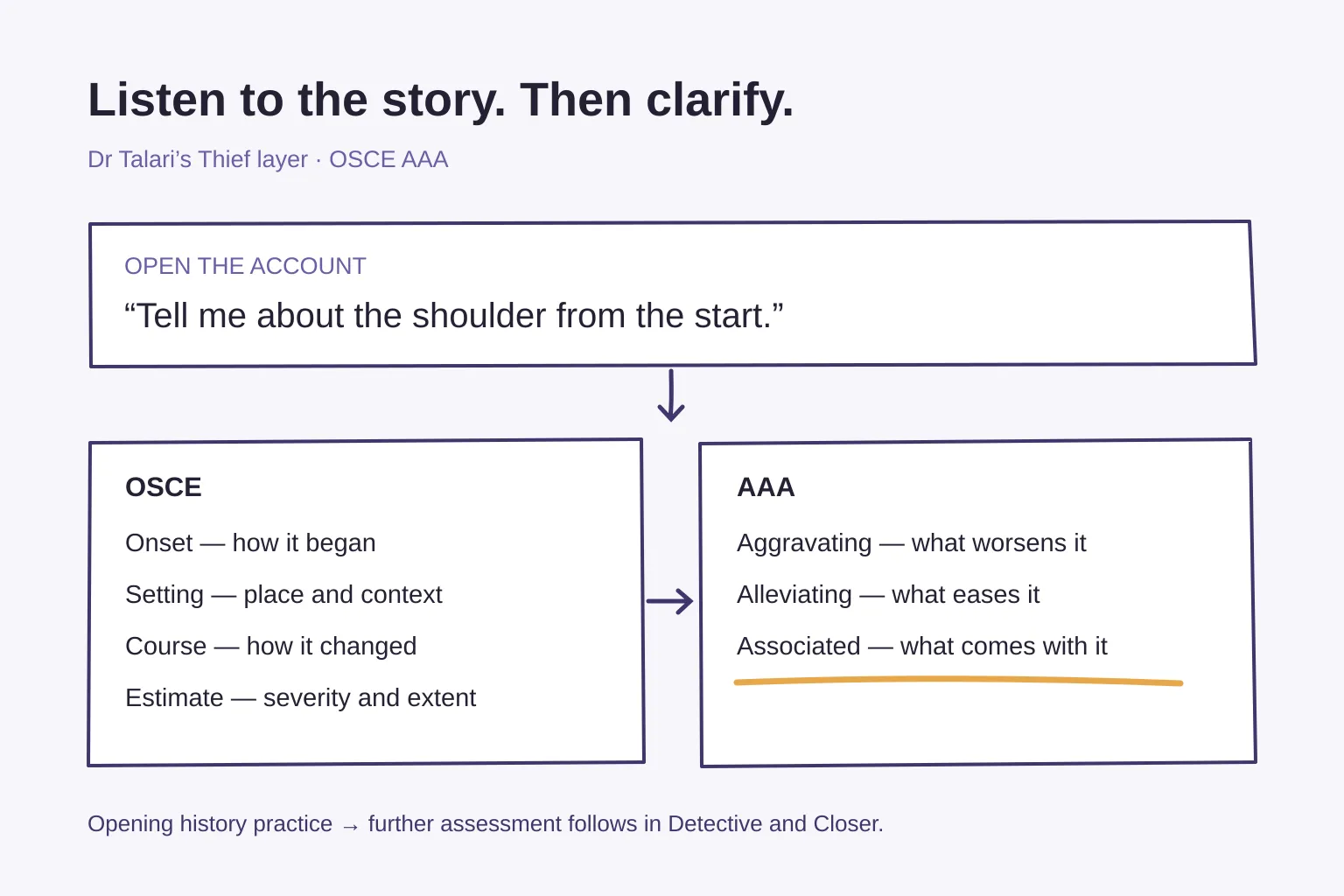
For OSCE history taking questions, begin with an open invitation, then clarify what the patient has already told you before asking about missing details. Dr Talari’s OSCE AAA structure organises that symptom history into Onset, Setting, Course, Estimate, Aggravating, Alleviating and Associated features. Medical students and international medical graduates can rehearse these questions without treating the mnemonic as a complete consultation or a diagnostic rule.
Learn. Train. Execute. Influence. Start by learning the question structure, practise it in a synthetic conversation, and take the reviewed history to teaching or supervision.
OSCE history taking questions in Dr Talari’s Thief layer
In The Dr Talari Complete OSCE Casebook — Volume II, the Thief layer means “steal the script”: hear the patient’s account, then explore it more specifically. It follows Salesperson, the introduction and rapport layer, and precedes Detective, the traffic-light assessment, and Closer, the later summary, examination and care steps. Those names are author teaching labels, not validated assessment instruments.
The source’s OSCE AAA prompts cover these domains:
- Onset: how and when the symptom began. “How did it first start?”
- Setting: where it happens and the surrounding context. “Where exactly do you feel it?” The casebook adapts this domain to the presentation rather than giving it one fixed question.
- Course: what has changed since it began. “Has it been getting better, worse or staying the same?”
- Estimate: severity or extent. “How much is it affecting what you can do?” A pain rating can add detail, but does not replace the person’s description.
- Aggravating: what makes it worse. “What have you noticed brings it on or makes it worse?”
- Alleviating: what makes it better. “What, if anything, eases it?”
- Associated: what else occurs alongside it. “What else have you noticed?” Follow the answer with presentation-specific questions.
The shoulder case illustrates how flexible these domains are: Setting includes location and spread; Course explores progression and stiffness; Estimate includes pain severity and its effect at night. Keep the source’s meaning, but choose questions that fit the account rather than reciting every phrase.
Start with a story, not seven questions at once
“Tell me about the shoulder from the start” gives the person room to describe an event, a pattern or an effect on daily life. Listen for information that already answers your planned questions. If the person tells you when the pain began, do not ask “When did it start?” again unless you need clarification.
Then narrow one uncertainty at a time. “When you say it’s worse now, what has changed?” follows the answer more closely than jumping straight to a pain score.
The GMC’s Good medical practice (2024), paragraphs 23 and 29, asks medical professionals to listen, acknowledge concerns and encourage an open dialogue. That supports listening before assumptions; it does not endorse this particular mnemonic.
Practise turning a vague shoulder story into a clear history
Here is a wholly synthetic teaching adaptation of the casebook’s shoulder-history component. It practises description only, not examination, diagnosis, imaging or treatment.
Patient brief: Casey, an adult, has an ache near the outer right shoulder. It began gradually three weeks ago, without a single remembered injury. It was initially noticeable only when reaching to a high shelf; now it happens during that movement most days. Lowering the arm eases it. Casey rates it four out of ten during the movement and has stopped putting heavy items on high shelves. There are no other symptoms in this bounded practice brief.
Begin with a sparse opening: “My shoulder’s been bothering me.” A useful continuation might be:
Learner: “Tell me about it from when you first noticed it.”
Casey: “It started a few weeks ago, reaching up. Now I notice it most days.”
Learner: “Did it begin with one particular injury, or come on gradually?”
Casey: “Gradually. I don’t remember hurting it.”
Learner: “You mentioned reaching up. Show me where you feel the ache.”
Casey: “Around the outside of this shoulder.”
Learner: “What happens when you lower your arm?”
Casey: “It settles.”
Continue by clarifying the change over time, severity, practical effect and associated symptoms. Ask only for details still missing. A human partner can use the patient brief and reveal information when invited, rather than reading the whole brief aloud.
The brief’s “no other symptoms” is a role-play boundary, not evidence that a real person has no serious underlying condition. In actual care, clinical urgency can change the order of questions; do not delay necessary assessment to finish the mnemonic.
Compare the history before and after your questions
Before clarification, the account is: “Shoulder pain, worse recently.” That leaves onset, location, pattern and impact unclear.
After clarification, a descriptive summary is:
“Casey describes three weeks of gradually developing outer right-shoulder aching, without a remembered single injury. It first occurred occasionally when reaching overhead and now occurs with that movement most days. Lowering the arm eases it. Casey rates it four out of ten during the movement and has stopped storing heavy items on high shelves. No other symptoms were reported in this exercise.”
The summary describes what Casey said. It does not turn “pain when reaching” into a confirmed diagnosis or claim that serious causes have been excluded. Nor is it the complete Closer layer: further assessment and the later care steps remain outside this exercise.
If you use an AI patient, keep the same case boundaries
Use an approved tool and invented information only. Paste the synthetic patient brief above, then add:
Play Casey one turn at a time. Start with “My shoulder’s been bothering me.” Answer only from the brief; do not invent additional history, examination findings or diagnoses. Reveal details when my questions invite them. Do not coach me during the conversation. If I ask for information outside the brief, say it is outside the practice case.
When I write STOP, leave the role. Quote my questions and identify which OSCE AAA domains they explored. Identify an unnecessary repeated question or a missing domain only if the transcript supports it. Do not give a competence score or clinical advice.
AI can add facts or mislabel questions. WHO’s 2024 guidance on generative AI in health warns about inaccurate and incomplete outputs. Stop if the case drifts; compare feedback with the actual transcript rather than accepting it as an assessment.
Fix the questioning habit that weakened the history
Read your transcript before any feedback. Mark each OSCE AAA domain with the patient’s answer, not just the question you asked.
- You asked three things in one turn. The answer may cover only the last one. Replay the turn with one question and wait for the response.
- You supplied the explanation. “So you strained it lifting?” introduces a cause Casey did not report. Ask how it began and preserve uncertainty.
- You collected a score but missed function. Four out of ten does not tell you what changed in daily life. Ask what Casey now avoids or cannot do comfortably.
- You recorded “no associated symptoms” without asking. The learner does not get credit for facts present only in the patient brief. Find the exchange that established the answer.
For students and IMGs, take the descriptive summary and one difficult exchange to a tutor. Ask whether you followed the account and represented uncertainty accurately. This exercise supplements supervised learning; it does not establish exam readiness or independent competence.
Educators can compare a transcript full of checklist questions with one that follows Casey’s answers. Have learners explain which details each question added, then replay the least useful turn. If making a teaching card, retain the attribution to Dr Talari’s Thief layer and label the card’s scope as symptom-history practice.
Practise the opening if listening is the difficult part
One Clinician’s free listening rehearsal for students and IMGs offers three fixed synthetic dialogue moments with phrase choices, explanations and retry. It practises Salesperson → Thief in an angry-patient opening; it is a separate listening exercise, not the shoulder-history drill above.
For the fuller prompt and listening sequence, read Angry patient role play: practise with an AI patient.
Teaching source and clinical scope
The OSCE AAA explanation and shoulder-history adaptation draw on Dr Talari’s Complete OSCE Casebook — Volume II, “The Method at a Glance” and the complete “Shoulder Pain” section. Only the history-questioning component is taught here. For real patient assessment, use current clinical guidance, your professional scope and appropriate supervision.